
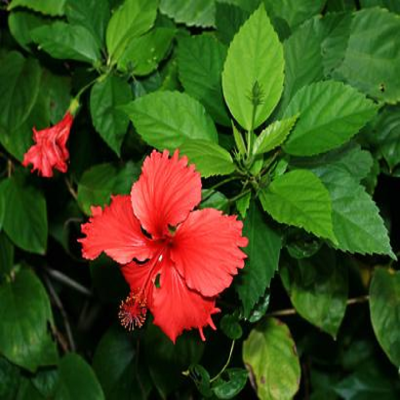
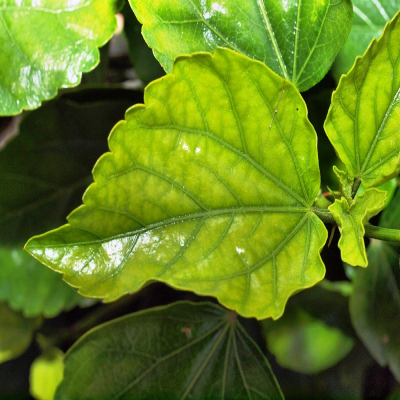
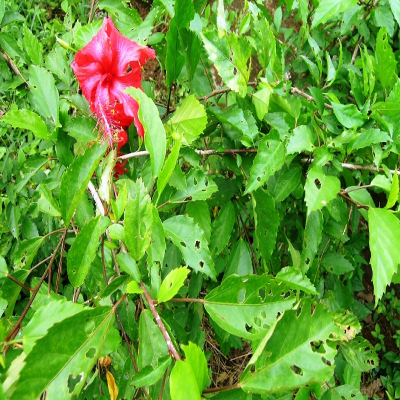
Hibiscus rosa-sinensis Linn.
Family : Malvaceae
Group : Anti-dandruff/Hair growth promoters
Parts Used : Root , Leaf , Flower
Vernacular Names :-
| English | : | Shoe- flower plant |
| Malayalam | : | Chemparatti |
| Hindi | : | Jasum |
| Sanskrit | : | Ondrapuspi |
| Assamese | : | Joba |
| Bengali | : | Joba |
| Gujarathi | : | Anghara-hindi |
| Kannada | : | Dasavala |
| Tamil | : | Cemparutti |
| Telungu | : | Mandara |
Distribution and Habitat: A native of China. It is grown as an ornamental plant in gardens throughout India and often planted as a hedge or fence plant.
Botany: Ever green, nearly glabrous shrub, 3-4 m tall with pale grey or whitish bark.
- Leaves: Simple, ovate, 6-10 x 3.5-7 cm, irregularly serrate dentate, shining green above. Stipules lanceolate –subulate.
- Flowers: 10-15 cm across, axillary, solitary. Pedicels 5-10 cm long or even longer, jointed above the middle. Bracteoles 5-7, linear- lanceolate, 1-1.5 cm long. Calyx long, divided almost to the middle. Petals red, oblanceolate, 5-10 cm long, entire or dentate at apex. Staminal tube exserted far beyond the petals.
Properties: Demulcent, febrifuge, emollient
Chemical constituents: 8-nonynoic,9- decynoic acids,taraxeryl acetate,β-sitosterol,sterculic and malvalic acids, quercetin and its glucosides, thiamine, riboflavin , niacin, ascorbic acid, carotene, kaempferol derivatives and fatty acid methyl esters.
Uses: It is used in cough, venereal diseases, menorrhagia, pruritus, fever, burning sensation, and fatigue, expulsion of the placenta, constipation, abscesses, inflammations, epilepsy, cerebropathy, cardiac debility and seminal weakness.
Agrotechnology
Soil: Well drained porous loamy soil.
Propagation: Cuttings, layering, budding, grafting and air layering.